
A Unique Approach to Care
What exactly is Naturopathic medicine? What does training to become a Naturopathic Doctor (ND) entail? How do visits and treatment differ from conventional medicine? These are commonly asked questions, especially since Naturopathic medicine doesn’t have a “standardized” scope of practice and licensure throughout the 50 states. In fact, there are still many states that have not obtained licensure, which often leads to individuals practicing as “Naturopaths” as it is often an unregulated term. These individuals may claim to be a Naturopathic doctor, but they have not received the extensive training required. It can be so confusing and difficult to determine what Naturopathic Medicine really is and how to find practitioners that are truly qualified and educated to provide care in this way.
History Behind Naturopathic Medicine:
Naturopathic medicine's primordial roots date as far back as the 18th and 19th century, with many contributors to its evolution. According to Nature Doctors (1994), one such direct influence was Father Sebastian Kneipp, a priest from Worishofen, Bavaria. He is thought to have originated the concept of "Nature Cure" by treating thousands of sick patients with natural remedies such as pure water, fresh air, exercise and herbal medicine. Father Kneipp "firmly believed that God, in nature, had provided remedies for nearly every human ailment". He saw a very ill patient named Benedict Lust, who 8 months later was completely healed. Lust then made it his life mission to bring the Kneipp Cure overseas to the US, and he did just that! He transplanted Kneipp's Nature Cure method into the US, added homeopathy and manipulative therapy, introduced it as Naturopathy, and opened the first school in 1896 in New York. Overtime, Naturopathy evolved into modern day Naturopathic Medicine and there are currently 7 accredited schools in the US and Canada. (4)
Naturopathic Medicine has been passed down throughout the generations ever since. It’s a beautiful and harmonious orchestra of traditional therapies, modern innovation, and sometimes a little magic that can’t always be explained by science. The fundamental belief is that our bodies are incredibly intelligent structures that have the innate desire to heal itself, with the appropriate help and support. Our goal as Naturopathic physicians is to listen to the patient and what their body is telling us, then fortify as needed and wait for the body to do what it does best, repair and thrive.
Training:
Licensed Naturopathic Doctors (ND) attend a 4-year accredited medical school, which requires a bachelor's degree and completion of pre-requisites prior to beginning the program. The first two years are heavily focused on basic sciences (like allopathic education) and the last two years are clinically focused with 1200 hours of clinical rotation, as well as 132 hours of outside preceptorship required.
Currently, there are only five accredited schools in Northern America:
Bastyr University (WA and CA campuses)
Canadian College of Naturopathic Medicine (Boucher and Toronto Campuses)
National University of Health Sciences (IL)
National University of Naturopathic Medicine (OR)
Sonoran College of Health Sciences (AZ) - formerly Southwest College of Naturopathic Medicine
In addition to attending a CNME (Counsel on Naturopathic Medical Education) accredited school, Naturopathic Doctors are required to take and pass two national board exams (NPLEX), one science-based exam after year two, and a more clinically focused exam after graduation to be able to practice medicine and obtain a medical license (2).
Principles of Naturopathic Medicine:
1. Healing Power of Nature (Vis Medicatrix Naturae)
Naturopathic medicine believes in the body’s inherent ability to heal and aids in this process by removing obstacles to cure, and providing support as needed.
2. Identify and Treat the Cause (Tolle Causum)
ND’s strive to identify and treat the root cause of illness instead of suppressing or managing symptoms.
3. First Do No Harm (Primum Non Nocere)
Naturopathic physicians aim to minimize risk by implementing the safest treatment options first, before utilizing higher force methods.
4. Doctor as Teacher (Docere)
ND’s provide education and work to empower their patients to build a collaborative relationship and encourage self-responsibility for their health.
5. Treat the Whole Person (Tolle Totum)
Naturopathic doctors get to know the mental, emotional, physical, environmental and genetic factors of patients and treat all aspects as they are integrally connected to health and wellbeing.
6. Prevention (Preventare)
In addition to treating disease, a strong emphasis is placed on preventing illness by assessing risk factors, intervening, and creating healthy foundational habits to reduce the likelihood of dysfunction occurring.
These principles are truly the crux of what makes naturopathic medicine different from conventional medicine. They provide a foundational philosophy for how we view disease, understand the healing process, and (most importantly) view the patient in front of us.
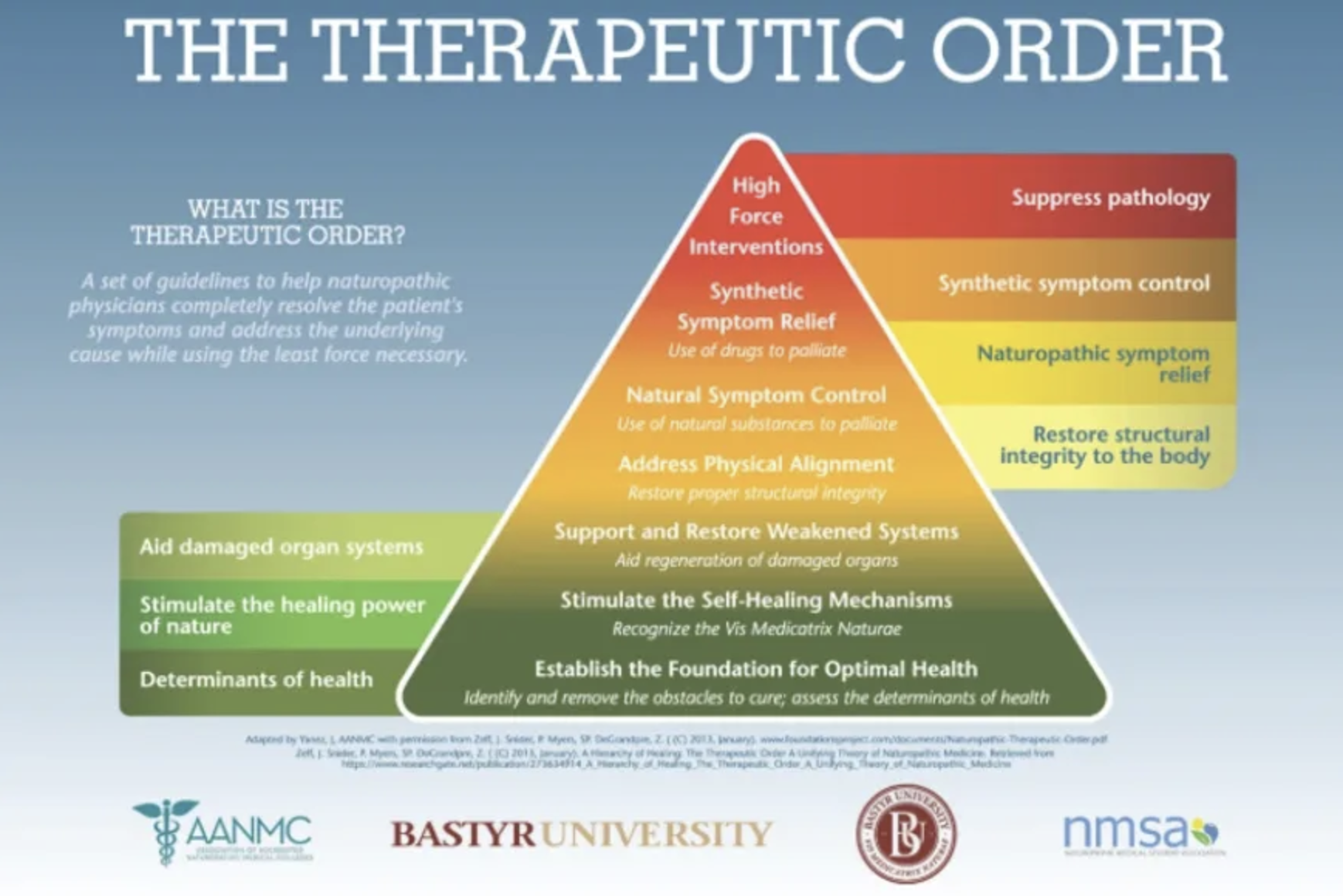
In recent years, Naturopathic medicine has adopted a tiered approach to care called the therapeutic order which builds off the 6 principles of Naturopathic Medicine. This pyramid displays the thought process behind clinical decision making, with the goal of implementing the less invasive, safer interventions first, and then moving up the pyramid to higher interventions, but only if indicated! This is in part to ensure unnecessary harm doesn’t come to the patient, but to also ensure foundational lifestyle components are in place before jumping to more risky interventions such as medications since it is easier to address the cause of dysfunction when foundational aspects of health are in place. It provides clarity when low hanging fruit is addressed and not masking the underlying cause.
What do visits look like with a Naturopathic Doctor?
Naturopathic visits often operate differently than conventional medicine appointments. Firstly, on average when you go see your conventional primary care provider, time spent with the doctor is generally 15 minutes or less, whereas Naturopathic visits are often at least 30 minutes and sometimes 1.5-2 hours (depending on the complexity and history of the patient). Treatments often follow the therapeutic order, with diet and lifestyle being a key foundational component for health. Other treatment options might include herbal medicine or homeopathy. For some patient’s hydrotherapy may be recommended as well to ease pain, reduce inflammation, and increase circulation to certain areas of the body. Naturopathic doctors often utilize functional laboratory testing and interpretation as another form of patient assessment to both treat and prevent illness. The visits are lengthy, but the time is spent truly getting to know the patient to best be able to assist them on their healing journey.
Hopefully this is helpful in increasing your understanding of what a Naturopathic Doctor is and what to expect. Fundamentally, ND’s work hand-in-hand with you to help you achieve your health goals, while acting as a conduit to encourage and provide the proper foundation for the body to restore and heal itself.
References:
1. https://aanmc.org
2. https://cnme.org
3. https://naturopathic.org/page/FAQ
4. Friedhelm Kirchfeld, & Boyle, W. (1994). Nature Doctors.